The Value of Kaoshikii Dance: A Psycho-Spiritual Bio-Energetic Practice
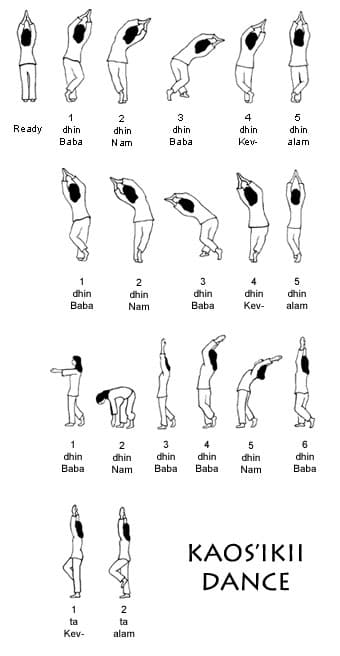
Kaoshikii dance was created in 1978 by Shrii Shrii Anandamurti as a psycho-spiritual exercise that benefits the mind by developing stamina and mental strength. Specifically designed for women's welfare, this powerful practice helps overcome fear while developing confidence and courage. Daily practice of Kaoshikii for 5 to 21 minutes generates tremendous physical and psychic energy, transforming both your physical and mental state.
Dancing is an expression of human life, while kiirtana is an expression of the human mind. There are countless expressions of the human self, but the particular nature of expression through dance combined with kiirtana brings the inner self outward, giving proper expression to our deepest nature. This unique combination of dance and kiirtana is called Kaoshikii. Kosa means "inner self," which is why this dance holds immense value in the psychic and spiritual dimensions of human life.
In the realm of action, three essential factors must be present: the action itself, the actor who performs, and the object upon which action is performed. But in the essence of philosophy, there exists a fourth factor beyond the arena of relativities—the witnessing factor. This Witnessing Entity remains like a mirror, reflecting all actions while maintaining its role as both passive observer and active catalyst.
When you see something, the object becomes the "seen," your eyes serve as the vehicle, and your optical nerve acts as the witnessing entity. Similarly, where thoughts become objects, the mind itself serves as the witnessing counterpart. Without the mind's approval and support, even perfect physical organs cannot function. You may walk past a horse on the road, but if your mind is elsewhere, you will not see it. When asked, "Didn't you see the horse?" you respond, "No, I was thinking about something else." Without mental support, physical functions remain imperfect and unrecognized.
In the case of mental functions, the mind becomes the objective counterpart, while the atman—the supreme knowing entity, the spirit—serves as the witnessing counterpart. All actions performed by all people, witnessed by all souls, remain unrecognized without the sanction of the Supreme Source, the Supreme Spirit, Paramatman.
Whatever we do is witnessed by Him. Nothing can be done secretly. Every action is reflected or refracted, and these reflections must receive support from the Supreme Source. Neither human nor animal can act in secret—everything is known to Him. This is why He is called Antaratma, the Inner Soul, the Supreme Soul. This all-witnessing entity is truly all-pervading.
Your mind-stuff, your ectoplasmic structure, exists within the scope of this supreme faculty. Every inter-ectoplasmic gap is filled with His essence—there is no vacuum. He is within, He is without, and He exists in closest proximity. You are never away from Him, never an outcast, and never hated by Him. Society may hate you, but He cannot, because the gaps in your ectoplasmic structure are filled by His presence.
What then is our duty? We must move along the path of righteousness, the path of beatitude. When we do so, all crude elements of this universe will first be converted into ectoplasmic substance, then into the form of cognitive faculty. Slowly, we become one with Him. When your mind becomes completely focused and refined, you achieve complete oneness with the Supreme.
This is why we sing in kiirtana: "Baba nama kevalam"—"Only that target, that goal, is yours." In life, there cannot be two goals. Through kiirtana, we ascribe divinity to all our internal and external objectives, gradually converting our very structure, our being, our sense of existence. Kevalam means this is the way, the route—there is no alternative.
When our psychic objective becomes crude, our entire psychic structure converts into matter, and we may eventually become matter ourselves. Parama Purusa, in the course of His thought projection, was first converted into matter. During pratisainchara—the introvert phase—we slowly become subtle due to internal clash and cohesion within matter. Through spiritual practice, we convert our entire entity not into the supra-mundane, but into the Supreme Cognitive Faculty, into Supreme Cognition. This is the path of spirituality—this is the path of humanity.
— From a discourse by Shrii Shrii Anandamurti, 30 May 1979, Valencia